
Metallography
Metallography is the study of topographical or microstructural features on specially-prepared microsectioned surfaces - typically polished and chemically etched.
In this technique, planar surfaces are prepared to obtain a polished finish. Chemical or other etching methods are often used to delineate macrostructure and microstructure features. Once prepared, samples are examined by the unaided eye, light microscopy, and/or electron microscopy. Microsectioning and metallography may reveal such information as grain size, characteristics of interfaces, and material anomalies. The microstructure features observed by metallography are directly related to the physical and mechanical properties of the material studied.
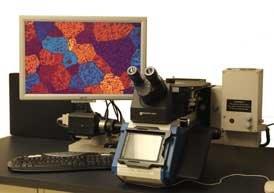
Smaller samples are embedded in plastic mounts for preparation. However, local areas of larger components can be prepared in place either in the laboratory or in the field. Examination in the field can be performed with portable microscopes or by preparing replicas of the surface for later examination in the laboratory.
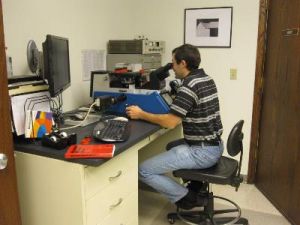
Typical Applications
- Metal alloy heat treatment verification
- Coating thickness measurement
- Weld or braze joint evaluation
- Case hardening depth determination
- Corrosion resistance evaluation
- Failure analysis
- Microscopic defects in IC devices
- In situ evaluation of thermo mechanical degradation
Contact us to discuss which evaluation method is best suited to solve your materials-related problems. Or visit our Handbook of Analytical Methods for Materials (HAMM) for more in-depth explanations and typical applications of the analytical methods used for the characterization and evaluation of materials and products.
Visit the HAMM for more information
The Handbook of Analytical Methods for Materials (HAMM) is a brief tutorial on techniques for materials characterization. The HAMM is intended to provide our visitors with enough information on a technique to determine whether it has the potential to help solve a materials problem.